A Dance of Fire and Ice: Calibration and Timing Guide
Published · 3 min read
A Dance of Fire and Ice looks like a game about reflexes. It is really a game about timing, and the most useful thing you can do for your timing happens before the first level: the Device Calibration screen. This guide covers that screen, how to read the path, and the habits that make the hard patterns playable.
Why calibration comes first
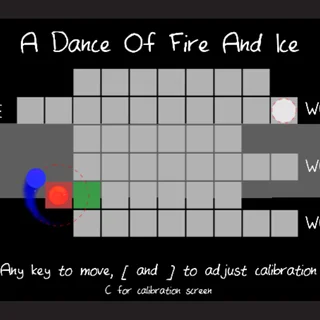
Your keyboard, screen and speakers all add a small delay. Wireless headphones add a big one. If the game did not know about that delay, you would hear the beat a moment after the game thinks it happened, and press late on every tile. The calibration screen fixes that. It says “Press to the beat. Join in anytime.”, plays a steady rhythm, and measures how early or late your presses land. If they are spread out it says “That was a little inconsistent. Press to try again.” If you stop pressing it says “Join in a bit more, don't be shy!” Once it has enough steady presses it saves the offset and grades you.
Do the test the way you will play: same headphones, same volume, same hand. Close your eyes if the moving planet distracts you — you are matching the sound, not the picture. If you change headphones later, press C on the title screen to take the test again.
Fine-tuning with [ and ]
The title screen reminds you: “[ and ] to adjust calibration”. These keys move the saved offset in small steps without redoing the test. The rule is simple. If you keep missing because the planet flies past the tile before you press, you are late — move the offset one step the other way and try again. Change one step at a time. A big jump makes it harder to tell whether the change helped.
Reading the path as music
Every tile is one press. What changes is how long you wait between presses, and the path shows it:
- Straight line. The swinging planet goes half-way round before it meets the next tile. This is the steady beat of the song.
- Right-angle corner. Only a quarter turn, so the next press comes after half the usual wait. Corners in a row are fast notes.
- Sharp hairpin. The planet barely moves before the next tile. These are the quickest notes in the game — often a quick double tap.
- Wide bend. More than half a turn, so you wait longer than usual. The danger here is pressing early out of habit.
Floor icons change the rules for everything after them. A snail slows the orbit and a rabbit speeds it up; two snails or two rabbits change it more. A swirl reverses the direction of the swing, so a corner that was a short quarter turn becomes a long three-quarter turn. Spot these icons before you reach them.
Habits that help
- Tap, don't press. Short, light taps are more even than full presses, and your finger is ready for the next note sooner.
- Alternate on fast parts. Any key counts, so put one finger of each hand on two keys and alternate through fast runs of corners.
- Count in. Say the beat under your breath for the first bar. It is easier to join a rhythm you are already counting.
- Use the percentage. When you fall, the level shows how far you got. If it is the same spot every time, study the shape of the path just before it rather than replaying from the start without thinking.
- Keep sessions short. Rhythm timing gets worse when your hand is tired. Five focused tries beat thirty tired ones.
That is the whole method: calibrate honestly, read the corners, listen more than you look. Play A Dance of Fire and Ice, or read how the web version differs from the full game.
More from the blog
- The A Dance of Fire and Ice Web Version: What It Includes
The free v0.4.2 web build: calibration, a title map you walk through, three worlds and saved stats — and what only the full Steam game has.